
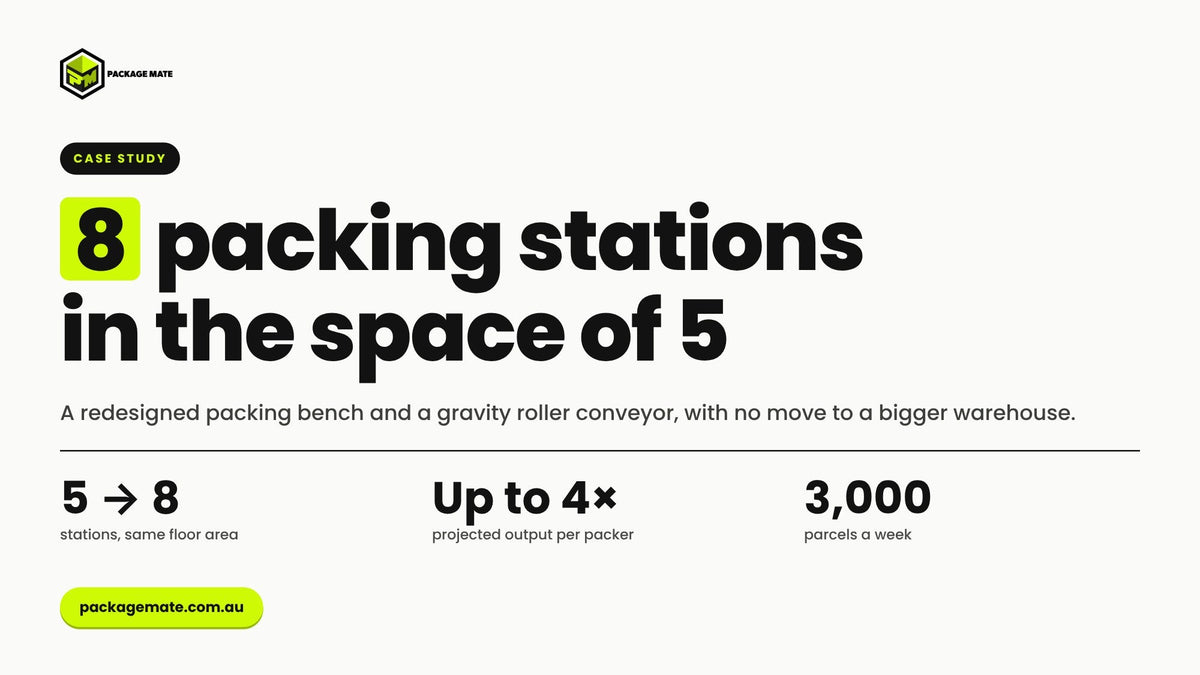
A redesigned packing bench and a gravity roller conveyor would take one warehouse from 5 packing stations to 8, in the same floor space, with no move to a bigger site.
A busy distribution business sending around 3,000 parcels a week asked Package Mate to review its packing area. Orders were growing, and the obvious answer, a larger warehouse, meant a new lease, a fit-out and months of disruption.
We visited the site, watched the packers through a normal shift, and came back with a workstation design and a product-flow plan. The brief: lift packing efficiency and throughput without increasing the footprint of the packing area.
At a glance
- Volume: around 3,000 parcels per week
- Problem: cluttered benches, loose cabling and constant walking
- Solution: custom 1850 mm packing workstation, back-to-back layout and gravity roller conveyor
- Projected result: 8 packing stations in the space of 5, and up to 4× output per packer
What we saw on the packing floor
Three problems were costing the team time on every parcel: a crowded benchtop, tangled cabling, and constant walking.
1. Only 40 cm of a 2-metre bench was usable
Printers, a standalone paper void-fill machine, label rolls and tools had taken over the work surface. Of a 2 m bench, roughly 40 cm was left free, enough for small cartons only. Larger boxes were packed on an upturned plastic crate on the floor.


2. No cable management
Under the bench, power leads, data cables and power bricks hung loose. That is a trip and snag hazard, and it makes every equipment change slower.

3. Packers spent their shift walking
With no storage at the bench, packers kept a single bundle of flat cartons on the table. When it ran out, they walked to fetch the next one. After sealing each parcel, they also walked it to the right courier pallet.
At 3,000 parcels a week, those short trips add up to hours of unproductive walking, time a packer is not packing.
The redesigned packing workstation
We designed an 1850 mm workstation that moves every machine off the benchtop and up or down into the frame, so the full surface is free for packing.


- Under-bench printer rack: the A4 laser printer and other bulky equipment move off the work surface.
- Middle shelf with two pull-out platforms: one for the high-speed label printer, one for the water-activated gummed tape machine. Both slide out when needed and tuck away when not.
- Space for two 15" monitors between the pull-outs, with a keyboard tray underneath for better ergonomics.
- Integrated 6-socket power board: every device plugs in at the bench, ending the loose cabling underneath.
- Roll bar with cutter set: holds kraft paper and roll labels. Packers pull and cut exactly the length of void fill they need, replacing a standalone machine that was slowing the line.
- Top-shelf carton dividers and a carton storage trolley: flat cartons sit within arm's reach, so packers stop walking to restock one bundle at a time.
The new product flow: packers stay put, cartons move
The layout rule was simple: the packer never leaves the bench. Pickers bring work in, and a gravity roller conveyor takes finished cartons out.

- Packing tables sit back-to-back in pairs, with two gravity conveyor lines running between them.
- A picker parks a trolley of picked orders in tote bins on the outer side of each bench.
- The packer takes a bin, then packs and seals the carton at the bench.
- The finished carton goes straight onto the gravity conveyor: no motor, no power, no walking.
- Cartons roll down to the pallet area, where a picker stacks each one on the right courier pallet.
- When a trolley is empty, the picker swaps it for the next loaded one, so the packer is never waiting.
Packing and pallet-building become separate jobs. Packers pack; pickers handle every movement in and out.
Projected results
The redesign fits 60% more packing stations into the same floor area and removes nearly all packer walking.
| Measure | Current setup | Proposed setup |
|---|---|---|
| Packing stations in the same area | 5 | 8 |
| Usable bench surface (2 m bench) | ~40 cm | Full bench |
| Walks to restock cartons | Every bundle | None: cartons stored at the bench |
| Walks to courier pallets | Every parcel | None: gravity conveyor |
| Cable management | Loose leads | Integrated 6-socket power board |
| Projected output per packer | Baseline | Up to 4× |
The biggest win is not a machine. It is time: when packers stop walking, almost every minute of the shift becomes packing time. Our estimate put each packer's output at up to four times the current rate.
Just as important, the extra three stations fit in the existing footprint. The business would not need to lease a larger warehouse to keep up with growth.
What any packing operation can learn from this
Before you look for a bigger warehouse, look at how your packers spend each minute.
- Clear the bench. Move printers and machines into the frame, above, below or on pull-outs. The work surface is for packing.
- Store consumables at arm's reach. Cartons, tape and void fill belong at the bench, not across the floor.
- Bring work to the packer. Trolleys parked at the bench remove the walk to collect orders.
- Let gravity take parcels away. A gravity roller conveyor needs no power and ends the walk to the pallet.
- Manage power and cables. An integrated power board is safer and makes changes faster.
Frequently asked questions
How can I increase packing throughput without a bigger warehouse?
Remove walking and clutter first. Store consumables at the bench, move machines off the work surface, and use a conveyor to carry finished parcels to dispatch. In this project, that approach fitted 8 stations where 5 stood before.
What is a gravity roller conveyor?
A sloped run of free-spinning rollers. Cartons roll along under their own weight, so it needs no motor or power supply and has very little to maintain.
Can Package Mate design a packing bench for my equipment?
Yes. We visit your site, measure your equipment and workflow, and configure benches, pull-out shelves, roll bars, storage and conveyors to suit.
Talk to us about your packing area
Package Mate supplies packing benches, workstation accessories, conveyors and packaging across Australia from Taren Point, NSW. If your packing team is running out of room, or spending more time walking than packing, get in touchand we'll come and take a look.